
Access Is Everything: Why Mindset Determines Whether Skill Shows Up

There is a phrase I often use with athletes: You can have the best swing in the world, but if your mind isn’t right, you will never access your true abilities. That idea has sparked some debate.
At the Golf Performance Center, we operate from a simple philosophy: success in golf is built on five essential elements. These include coaching/technique, physical performance, properly fitted equipment, mental skills, and desire. Each of these plays a critical role. Remove any one of them, and the system begins to break down.
This is not a hierarchy. It is a system.
When these five elements come together, something powerful happens. The whole becomes greater than the sum of its parts. A technically sound swing supported by efficient movement, properly fit equipment, strong motivation, and well-developed mental skills creates the foundation for high-level performance.
And yet, there is something important that often gets overlooked.
You can develop skill in all five elements and still struggle to perform. You can build a technically sound swing, improve your physical capabilities, invest in properly fit equipment, strengthen your motivation, and even learn the mental skills required to perform at your best. And still, when it matters most, those skills do not show up.
Why?
Because development is not the same as access.
What determines access is not another skill. It is not another element. It is the state of mind the athlete is in when they are trying to learn or perform.
From a psychological and neurophysiological standpoint, this matters more than most people realize.
When an athlete is in the right mindset, one that is curious, open, and engaged, the brain enters a state that supports learning. The prefrontal cortex, which is responsible for attention, decision-making, and problem solving, is actively engaged. At the same time, the anterior cingulate cortex helps detect errors and signals when adjustments are needed. Dopamine, a neurotransmitter associated with motivation and reinforcement, increases, helping the athlete stay engaged and repeat successful patterns.
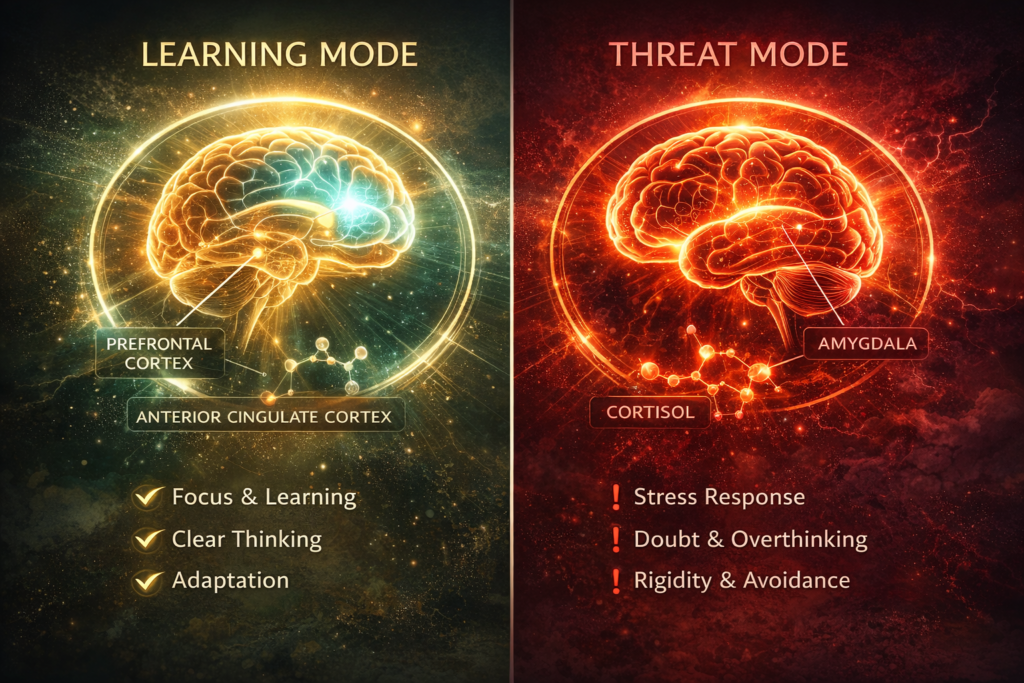
In this state, the athlete can take in information, evaluate it, and make meaningful adjustments. Over time, this is how skill is built.
But when the mind shifts into a state of judgment, fear, or outcome fixation, the system changes. The amygdala, which is responsible for detecting threat, becomes more active. Cortisol, a stress hormone, is released. These changes reduce the effectiveness of the prefrontal cortex, making it harder to think clearly, stay present, and process feedback.
Attention narrows or becomes scattered. The ability to process information and make adjustments declines. In this state, learning slows down or stops altogether.
In simple terms, instead of asking, “What can I learn from this?” the athlete starts thinking, “What does this say about me?”
That shift alone is enough to interfere with development.
The same principle applies in performance.
The mindset required to build a skill is not the same as the mindset required to express it. In practice, the athlete needs to be engaged and adaptive. In competition, the athlete needs to be clear, committed, and able to trust what has already been built.
When the mind is in the right state, the athlete can access what they have developed. Movement becomes more fluid because well-learned motor patterns can run automatically. Decisions become clearer. The game simplifies.
When the mind is not in the right state, interference shows up. The athlete begins to overthink, over-control, or second-guess. The prefrontal cortex becomes overactive or misdirected, attempting to consciously control movements that should be automatic. Attention shifts away from the task. The result is often tension, inconsistency, and a gap between ability and performance.
This is something every golfer has experienced. A player can stripe it on the range, then step onto the first tee and feel like they have lost their swing. Nothing changed physically. Nothing changed technically. What changed was the state of mind.
This is why mindset matters.
Not because it replaces the other elements, but because it determines whether those elements can be developed and expressed.
Technique still matters. Physical ability still matters. Equipment still matters. Desire still matters. The mental skills that fall under the mental game still matter.
But without the right mindset, the athlete cannot fully access any of them.
That is not an opinion. It is a function of how the brain works.
Ultimately, performance is not just about what you have built. It is about what you can access when it matters.
And access begins with the state of your mind.