
Why stress in golf doesn’t reset and how it builds over the course of a round
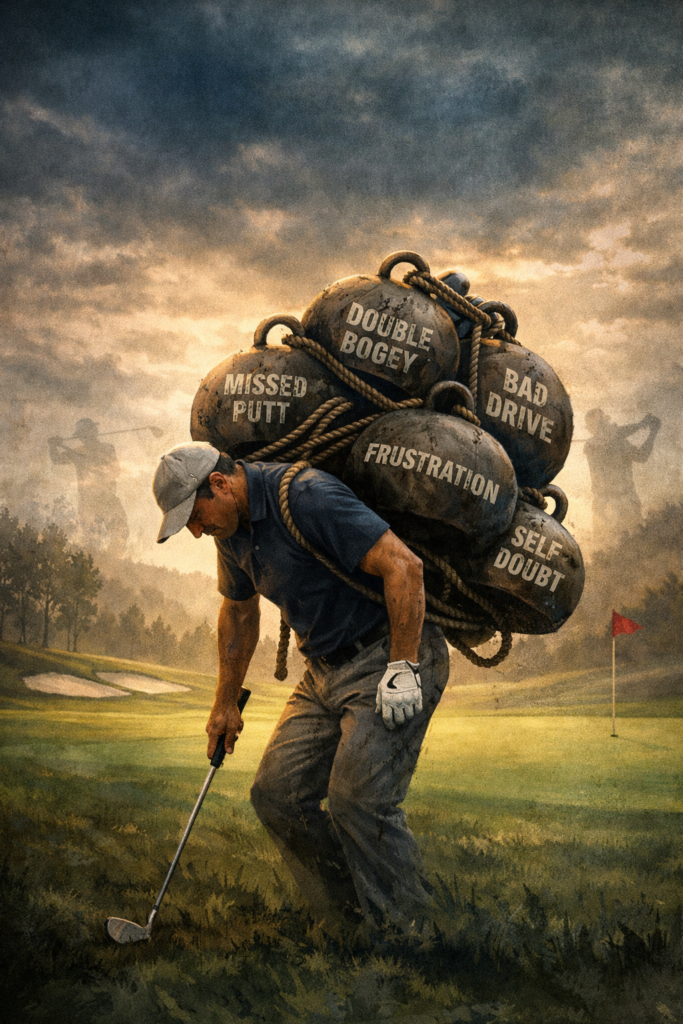
There is something every golfer carries with them from one shot to the next. Not just the club in their hand or the yardage in front of them, but the residue of what has already happened. A missed putt. A poor decision. A moment of doubt. And over the course of a round, that weight builds. Imagine that every time you experience a distressing moment, a physical weight is attached to your body. At first, you might not notice it. But if those moments go unchecked, by the end of the round you would be so weighed down you could not move with any freedom. Your posture would change. Your movement would tighten. Everything would feel heavier. Now consider this. If that were true, how do you think you would perform?
Golf presents itself as a series of independent events. One shot, then another. One hole, then the next. We reinforce this idea with familiar advice: “Forget it.” “Next shot.” “Move on.” And while those phrases are well-intentioned, they can be misleading. Because the truth is, you probably do not move on nearly as cleanly as you think you do. The body does not reset instantly. The mind does not clear on command. Emotion does not disappear just because you tell it to. Instead, something more subtle happens. You carry it with you.
Most players think of stress as something that comes and goes. A bad shot creates stress. A good shot relieves it. But over the course of a round, stress behaves differently. It accumulates. Each shot leaves behind a trace: a slight increase in tension, a subtle shift in attention, a quiet change in belief. On their own, these changes are barely noticeable. But over time, they stack. By the back nine, you are no longer just playing the course. You are playing the accumulation of everything that has happened so far.
As stress builds, it begins to quietly change the way you perform. First, it alters the way you think. Attention narrows. Instead of asking, “What’s the best shot here?” you begin asking, “How do I avoid another mistake?” or “How do I make up for that bogey?” Decision-making shifts from clear and intentional to reactive and emotional. In a game defined by process and precision, that shift is costly.
It also changes the way you feel. Frustration lingers longer than it should. Doubt becomes easier to access. Over time, you are no longer responding to the shot in front of you. You are responding to the story you have been building all day. A story about how you are playing, what is going wrong, and what needs to change. That story grows heavier with every hole.
And eventually, it changes the way you move. The swing begins to feel off. Tempo changes. Timing becomes inconsistent. But the issue is not mechanical. It is physiological. As stress accumulates, muscle tension increases, arousal rises, and coordination declines. Your body shifts from a state of freedom and trust to one of control and protection. And that is not where great golf lives.
Players often say, “I was fine early… I just lost it.” But they did not lose it. They accumulated it. What looks like a sudden drop in performance is almost always the result of something building over time. By the later holes, decision-making is compromised, emotional control is reduced, and execution is strained. This is not because of one moment, but because of all of them. Golfers do not fall apart because of one bad shot. They fall apart because they carry that shot with them.
At some point in the round, the opponent changes. It is no longer just the course or the competition. It is the weight of everything you have been carrying throughout the round. And most players are unaware of just how heavy that has become.
From “Move On” to “Let Go”
If stress is cumulative, then performance is not about ignoring it. It is about dealing with it intentionally and consistently. There is a difference between telling yourself to move on and actually letting something go. One is an idea. The other is a skill. And like any skill, it can be trained.
There are three moments where this skill can be developed. Before the round. During the round. And after the round.
Before the Round
Before the round, the goal is to reduce what you bring with you to the first tee. Many players arrive already carrying expectations, swing thoughts, or residual frustration from previous rounds. A simple way to work on this is to take a few minutes before you play and write down anything that feels unresolved. A poor range session. A swing thought that is lingering. A result you are trying to prove. Once it is written down, make a clear decision about what belongs in today’s round and what does not. The act of identifying and externalizing these thoughts helps create separation. You begin the round lighter, more present, and more intentional about where your attention will go.
During the Round
During the round, the goal is to prevent accumulation. After a distressing shot, most players either dwell on it or try to force themselves to ignore it. Neither is effective. Instead, build a simple reset between shots. This can be as brief as a breath, a physical cue, or a consistent phrase. For example, as you walk away from the shot, take one slow breath and say to yourself, “That one is done.” Then deliberately shift your attention to something neutral or task-relevant, such as the next yardage or the wind. The key is not to pretend the shot did not happen, but to acknowledge it and then create a clear boundary so it does not follow you into the next one.
After the Round
After the round, the goal is to process without carrying forward unnecessary weight. Many players either overanalyze their round or avoid reflecting on it altogether. A more effective approach is to briefly review the round through a structured lens. Identify one thing you did well, one thing you would like to improve, and one specific intention for your next round or practice session. Once that is done, close the loop. The round has been acknowledged, learned from, and completed. There is no need to continue carrying it.
A Different Way to Think About Performance
What if the goal was not just to hit good shots, but to arrive at each shot as free as possible from the last one? What if performance was not just about execution, but about how much you are carrying when you execute? Because the reality is simple. The lighter you are, the better you play. The heavier you are, the harder the game becomes.
Golf does not just test your swing. It tests your ability to release what has already happened. And most players do not struggle because they lack skill. They struggle because they continue to hold on to the past.